The “3-Person Unicorn” Has a Fatal Flaw: It Forgot the Architect
I’ve been reading a lot about building startups and founding teams in the new AI-era. I came across the NFX article on the “3-Person Unicorn Startup” after seeing a few friends on Linkedin talking about it. If you haven’t read it, the thesis is compelling. It argues that with the leverage of Generative AI, the next billion-dollar company will be built by just three people: a CEO (the seller), a CTO (the builder), and a broad Generalist (the operator).
I love the optimism of this concept. I love solving hard problems with emerging technologies, and I thrive on the idea that small, insanely smart teams can outmaneuver incumbents.
However, I believe this model overlooks a critical organ in the startup anatomy.
The NFX framework assumes that if you can code it and sell it, you have a business. But after a decade of building companies, securing patents, and navigating the unforgiving terrain of healthcare and hard tech, I see a massive gap in this 3-person lineup.
They are missing the Experience Architect.
You need a human obsessed with design interaction and holistic optimization. If you don’t have this, you might build a technical marvel that solves the world’s biggest problems, but you will end up with a “shit product” that no one can actually use.
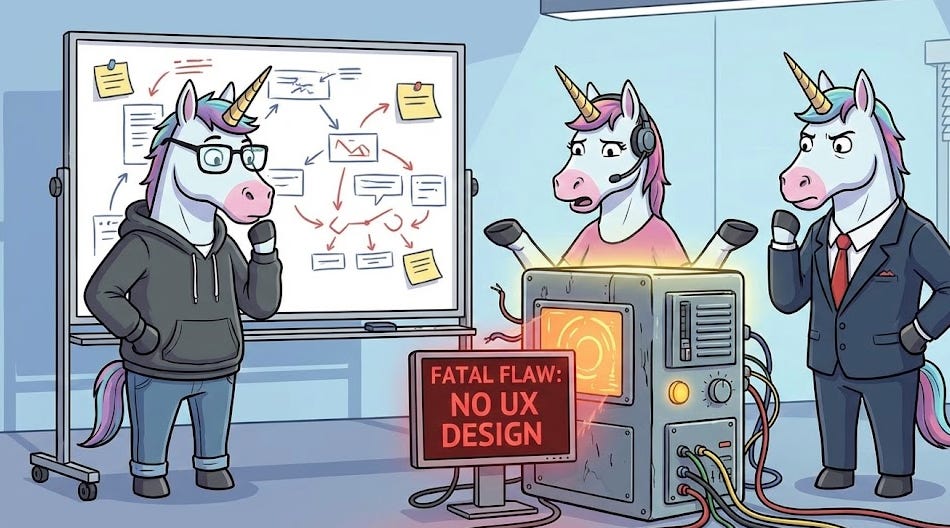
The Illusion of AI Competence in Design
I have built 5 companies and grown 2 of them to significant annual recurring revenue. I have successfully applied for and won 10 NIH grants, resulting in over $2 million in non-dilutive funding. In my world, which often intersects with healthcare, education, data governance, and complex hardware, “user error” isn’t just a churn metric. It is a failed clinical trial or a rejected patent.
I see founders falling into a trap where they believe AI covers the “design” vertical because it can generate CSS or copycat a landing page structure.
This is a mistake.
AI models today are incredible at execution. They can write the Python script to analyze data. They can draft the SQL query. But most AI models cannot think through the experience wholistically. They cannot navigate the infinite and often illogical permutations of user actions.
AI does not have empathy. It cannot feel the frustration of a nurse trying to input patient data at 3 AM. It cannot sense the friction a non-technical user feels when navigating a climate-tech dashboard.
AI can help with bringing in design and Product-Led Growth (PLG) best practices, but you need a human in the loop to navigate and decide.
The Missing Founder
In the NFX model, the CTO is leveraging AI to code faster. The CEO is leveraging AI to sell faster. But who is ensuring the product actually makes sense?
I believe you need one of your co-founders to be purely interaction-focused.
Alternatively, if your team is truly limited to three people, the “Generalist” cannot just be an operations person. They must be a product designer who understands systems engineering.
I have seen technically superior products fail because the interaction layer was treated as an afterthought. In the age of AI, features are becoming a commodity. The code is cheap. The logic is accessible.
The moat is no longer “can we build it?” The moat is “does using this feel like magic?”
Why Systems Thinking Matters More Than Ever
My passion for building expresses itself in two ways. I run my own startups, and I serve as a commercialization partner for other innovators. I help founders navigate the path from a raw idea to a defensible product.
When I look at my work in systems engineering and cloud infrastructure, I see that complexity is increasing, not decreasing. AI adds layers of capability, but it also adds noise.
A pure coder (CTO) often thinks in terms of efficiency and inputs/outputs. A pure seller (CEO) thinks in terms of value propositions.
The Experience Person thinks in terms of flow.
I have spoken at conferences around the world from the LoRa Alliance World Expo in Paris to TEDx in Dayton, Ohio, talking about how technology shapes the world. One constant truth I have observed is that human attention is the scarcest resource.
If you rely on AI to design your product flow, you are relying on a statistical average of what already exists. You aren’t innovating on the experience. You are regressing to the mean
.
The Revised Playbook
I am not arguing against the lean startup. I have managed hardware, software, and research teams, and I know the power of keeping headcount low. But if I were building a “3-Person Unicorn” today, specifically in high-stakes markets like education, climate, or health, I would tweak the roster.
- The Visionary/Seller (CEO): Finds the market and tells the story.
- The AI-Augmented Builder (CTO): Orchestrates the code and infrastructure.
- The Experience Architect (CDO/CPO): The human in the loop. The person who translates “best practices” into a specific, optimized user journey.
If you leave that third seat empty, or fill it with a generic operator, you will build a fast car with square wheels.
We are entering a golden age of building. The barrier to entry has never been lower. But the bar for user experience has never been higher.
Don’t let the AI do the thinking for you. Let it do the work. You do the design.